An unbiased compressor can move a game away from equilibrium even when every player computes an exact gradient. The problem is what enters the compressor. A strategy can be large at equilibrium, while the change proposed by a deterministic local round is zero there. Balani, Yoon and Loizou use this distinction to redesign communication in per-player local SGD. A coupled two-player example below gives an exact error floor for direct strategy compression. Balani et al., arXiv:2611.08686v1, Section 2.
What the server relays
Each player \(i\) owns a block \(x^i\) and minimizes its own loss in that block. Write \(F(x)=(\nabla_i f_i(x))_i\) for the concatenated own-strategy gradients. With unconstrained, differentiable and own-block convex losses, a Nash equilibrium \(x_\star\) is a zero of \(F\). Within a communication round, each player takes \(\tau\) steps on its own block while using the other players’ last synchronized blocks. Let \(u\) concatenate the resulting differences between local endpoints and round-start blocks. The server relays the compressed blocks, and every player adds them to its copy of the shared state. The updates \(Q(x+u)\) and \(x+Q(u)\) agree when \(Q\) is the identity. Sections 2.1–2.2, Algorithm 1.
The compressor is conditionally unbiased and satisfies \(\mathbb E[\lVert Q(v)-v\rVert^2\mid v]\leq\omega\lVert v\rVert^2\). The compressor uses fresh randomness independent of the history and local gradient draws. Conditioning on \(x,u\) removes the cross term in the squared error. Increment compression thus gives
\[\mathbb E[\lVert x^+-x_\star\rVert^2\mid x,u] \leq \lVert x+u-x_\star\rVert^2+\omega\lVert u\rVert^2.\]A deterministic round started at \(x_\star\) has \(u=0\), and the relative variance bound forces \(Q(0)=0\) almost surely. Direct strategy compression instead evaluates its noise at \(x_\star\). It can move the state whenever the compressor has positive variance at that particular vector. Section 2.2, Appendix B, Equation (15).
A two-player game with an exact error floor
Let \(x_\star=(1,1)\) and \(e=x-x_\star\). Take losses \(f_1=\tfrac12 e_1^2+\tfrac12e_1e_2\) and \(f_2=\tfrac12 e_2^2-\tfrac12e_1e_2\). Their own gradients are \(F(x)=Me\), where \(M=\begin{pmatrix}1&1/2\\-1/2&1\end{pmatrix}\). The cross terms cancel in \(\langle F(x),e\rangle=\lVert e\rVert^2\), and \(M^\top M=\tfrac54 I\). The game satisfies quasi-strong monotonicity with \(\mu=1\) and star-cocoercivity with \(\ell=5/4\). In these conditions, the same inner product bounds both distance to equilibrium and the squared norm of the joint gradient.
Use one exact local step of size \(\gamma=1/2\) per round. Write \(A=I-\gamma M\), so the uncompressed endpoint is \(x_\star+Ae\) and the increment is \(-\gamma Me\). Direct multiplication gives \(A^\top A=\tfrac5{16}I\). For each scalar coordinate, independently in each round, let \(Q(v)\) return \(0\) or \(2v\) with equal probability. This toy compressor has mean \(v\) and variance \(v^2\).
- Compress the increment. The next error has mean \(Ae\) conditional on \(e\). The expected squared norm adds the variance \(\gamma^2\lVert Me\rVert^2=\tfrac5{16}\lVert e\rVert^2\) to \(\lVert Ae\rVert^2\). The total is \(\tfrac58\lVert e\rVert^2\). For instance, from \(e=(1,0)\), the four equally likely next errors are \((1,0)\), \((1,1/2)\), \((0,0)\) and \((0,1/2)\). Their squared norms average to \(5/8\).
- Compress the strategy. The conditional mean error is still \(Ae\), but the variance adds \(\lVert x_\star+Ae\rVert^2\). Starting at equilibrium makes \(\mathbb E[e_p]=0\) in every round \(p\), which removes the linear term in the expansion of that variance. The mean-square error \(m_p=\mathbb E\lVert e_p\rVert^2\) then follows
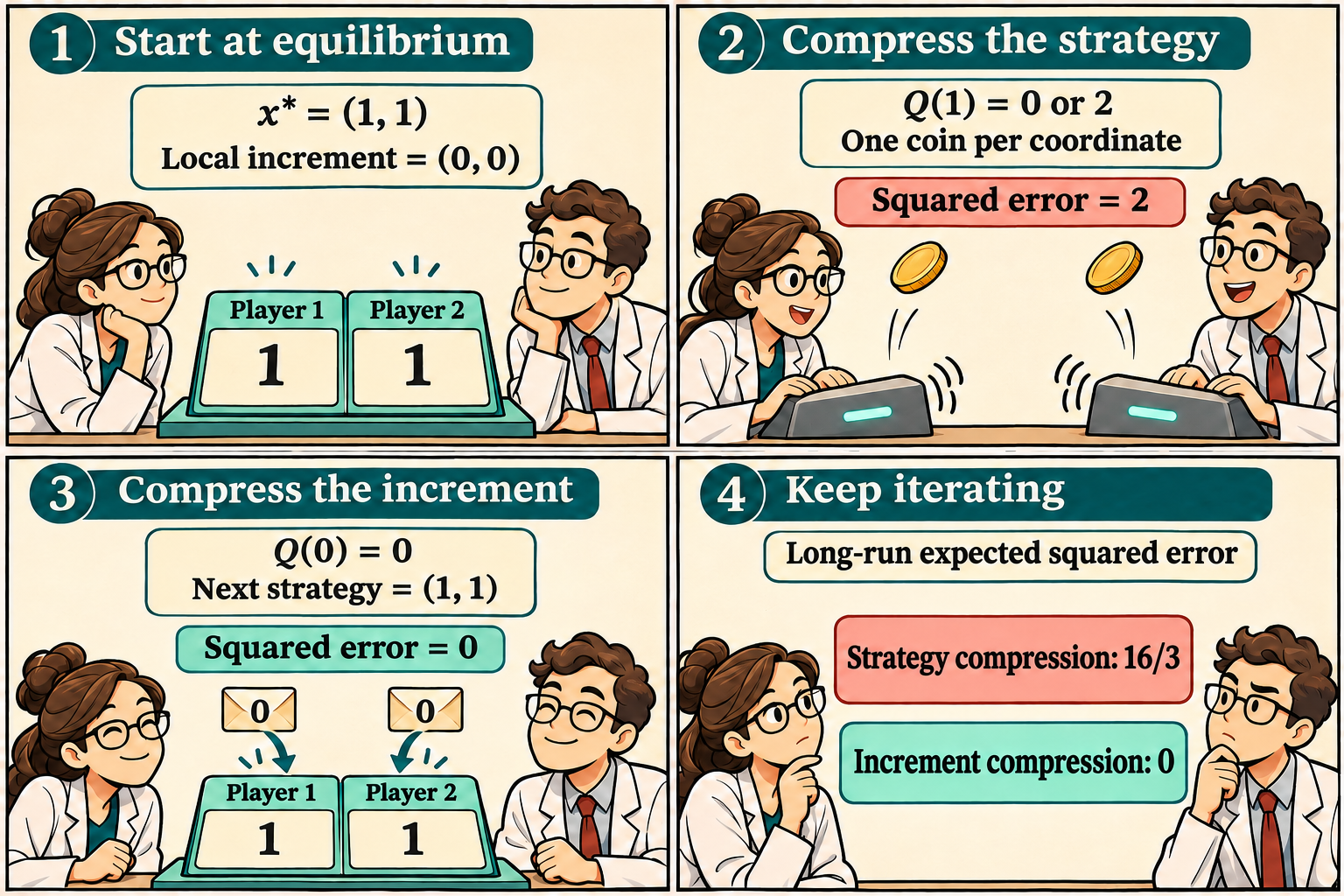
The comic starts both methods at the equilibrium. In the direct strategy branch, both coordinates are at distance one from their equilibrium values after the first message. The joint squared error is two for all four outcomes. In the increment branch, the same random rule receives zero and both strategies stay at one. The last panel shows the limit under continued iteration. A plot of the mean strategy would put both methods at the equilibrium throughout this run and miss the error floor entirely.
When a vanishing increment is a reasonable expectation
The proof turns the compressor variance into a term proportional to the expected squared increment. The paper’s relative monotonicity and cocoercivity conditions, together with the own-block smoothness and step-size bounds, control this term and yield a geometric mean-square bound. Ordinary minibatches can produce a nonzero update even at equilibrium, giving a neighborhood bound with a constant step size. In finite sums with smooth components, the SVRG variant pairs two gradients from the same minibatch and adds the full round-start gradient. At equilibrium the paired terms cancel and the full gradient vanishes. Equation (3), Theorem 4.2 and Corollaries 4.5–4.6.
The paper tests random coordinate sparsification on a synthetic quadratic game and a simulated spectrum-sensing task. In the quadratic experiment, compressed SVRG reaches high accuracy with fewer communicated bits than the other tested variants. The full gradient computed at each round start adds local work. Section 5.
For deployments with intermittent clients, I would test versioned increments against periodic full-state checkpoints. The update rule assumes everyone starts each round with the same joint state. If one recipient misses a broadcast, adding later increments alone preserves that missing offset until a repair, even if the server sends those later increments perfectly. At a fixed target error, count uplink and downlink bytes including repair traffic, as well as gradient calls. This would show how much of the bit advantage survives the cost of keeping replicas synchronized.
The comic was created with AI.