Complementary evidence becomes useful when each source bounds the part of the loss it actually constrains.
Şen, Selvi, Pauphilet, and Kuhn’s Efficient Data Fusion in Distributionally Robust Optimization, first public November 25, studies intersections of ambiguity sets. Proposition 1 separates source-specific worst-case expectations through loss majorants. Proposition 2 and Corollary 1 use zero-sum corrections to obtain separable upper bounds. Their affine multipliers generate quadratic corrections; static multipliers generate linear ones.
An original example: two reports about one distribution
Let the uncertain scalar have three possible values,
\[\Xi=\{-1,0,1\},\qquad p=(p_-,p_0,p_+)\in\Delta_3,\]where \(\Delta_3\) is the set of nonnegative probability triples summing to one. Consider loss \(\ell(\xi)=\xi^2\), so its expected value is \(p_-+p_+\).
Suppose two reports constrain the same unknown distribution:
\[\mathcal B_- =\{p\in\Delta_3:p_-\leq1/5\}, \qquad \mathcal B_+ =\{p\in\Delta_3:p_+\leq1/5\}.\]Each report leaves the opposite tail unrestricted. Under \(\mathcal B_-\) alone, the adversary can choose \(p=(0,0,1)\); under \(\mathcal B_+\) alone, it can choose \(p=(1,0,0)\). Both choices incur expected loss one. Since \(\xi^2\leq1\), both are maximizers.
Consequently, averaging the two separate worst-case values gives
\[\tfrac12\sup_{p\in\mathcal B_-}\mathbb E_p[\xi^2] +\tfrac12\sup_{p\in\mathcal B_+}\mathbb E_p[\xi^2]=1.\]This calculation permits a different adversary for each report. Requiring one distribution to satisfy both reports instead gives
\[V=\sup_{p\in\mathcal B_-\cap\mathcal B_+}(p_-+p_+)\leq2/5.\]The bound is attained by \(p^\star=(1/5,3/5,1/5)\). Thus \(V=2/5\), and the intersection is visibly nonempty.
Transfer the loss to the right evidence
Define two functions on this three-point support:
\[\lambda_-(\xi)=\frac{\xi^2-\xi}{2},\qquad \lambda_+(\xi)=\frac{\xi^2+\xi}{2}.\]Their values at \((-1,0,1)\) are respectively \((1,0,0)\) and \((0,0,1)\). They are exactly the left- and right-tail indicators on \(\Xi\), and they sum pointwise to \(\ell\). Therefore,
\[\sup_{p\in\mathcal B_-}\mathbb E_p[\lambda_-]=1/5, \qquad \sup_{p\in\mathcal B_+}\mathbb E_p[\lambda_+]=1/5.\]For every common feasible \(p\),
\[\mathbb E_p[\ell] =\mathbb E_p[\lambda_-]+\mathbb E_p[\lambda_+] \leq1/5+1/5=2/5.\]This certificate solves two separate source problems and matches the feasible witness. It needs no search over coupled probability triples.
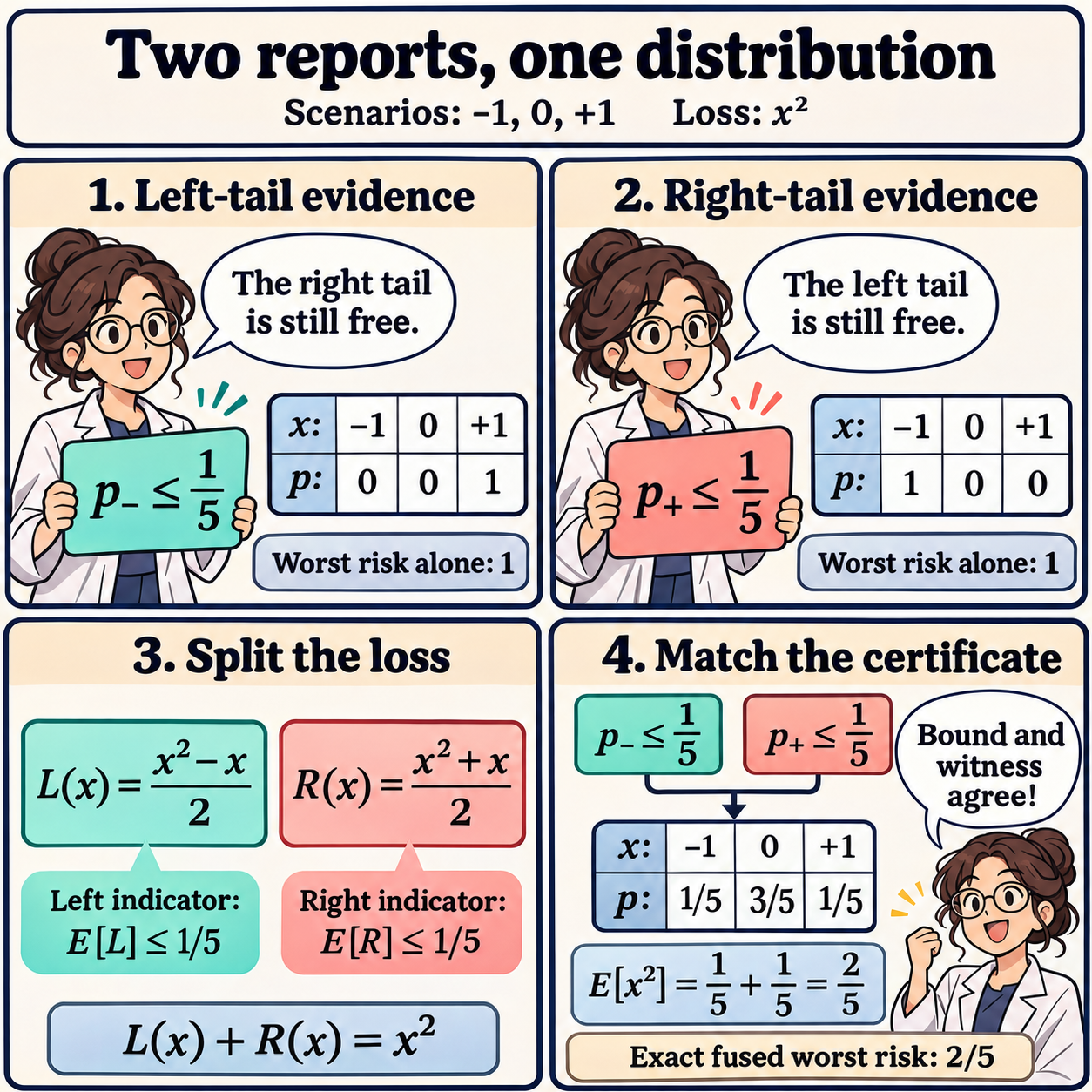
The reports concern one common distribution. The numbers are exact worst-case expected losses in the three-scenario example.
The corrections \(-\xi/2\) and \(+\xi/2\) cancel. This is the paper’s static choice \(a_-=-1/2,a_+=1/2\).
The order of operations matters: cancel under a shared feasible distribution, then bound each expectation using its own evidence. Taking separate suprema first loses that compatibility.
The same construction can select a decision
Now choose a prediction \(\beta\in\mathbb R\) and incur \(\ell_\beta(\xi)=(\beta-\xi)^2\). To make the decision asymmetric, change the caps to \(p_-\leq1/5\) and \(p_+\leq2/5\). Denote this intersection by \(\mathcal P'\) and its robust risk by
\[\mathcal R(\beta)=\sup_{p\in\mathcal P'}\mathbb E_p[(\beta-\xi)^2].\]For \(-1/2\leq\beta\leq1/2\), expanding the expectation gives
\[\beta^2+(1+2\beta)p_-+(1-2\beta)p_+.\]Both tail coefficients are nonnegative, so filling both caps maximizes the expression. The remaining mass is \(2/5\) at zero. Hence,
\[\mathcal R(\beta) =\beta^2+\frac35-\frac25\beta =\left(\beta-\frac15\right)^2+\frac{14}{25} \quad\text{for }\lvert\beta\rvert\leq1/2.\]This suggests \(\beta^\star=1/5\) with risk \(14/25\). It is also globally optimal over all real decisions: the single feasible distribution \(q^\star=(1/5,2/5,2/5)\) gives
\[\mathcal R(\beta)\geq \mathbb E_{q^\star}[(\beta-\xi)^2] =\left(\beta-\frac15\right)^2+\frac{14}{25} \qquad\text{for every }\beta\in\mathbb R.\]Equality is attained at \(\beta=1/5\). The strict square proves uniqueness without extrapolating the formula for the restricted interval.
There is a matching separated certificate. Write \(I_-(\xi)=\mathbf1\{\xi=-1\}\) and \(I_+(\xi)=\mathbf1\{\xi=1\}\), and set
\[\lambda_{-,\beta}=\frac{\beta^2}{2}+(1+2\beta)I_-,\qquad \lambda_{+,\beta}=\frac{\beta^2}{2}+(1-2\beta)I_+.\]They sum to \(\ell_\beta\) on \(\Xi\). At \(\beta=1/5\) their source-wise suprema are \(3/10\) and \(13/50\), totaling \(14/25\).
The corrections relative to \(\ell_\beta/2\) are \(\beta\xi^2-\xi/2\) and its negative. They correspond to affine multipliers; at \(\beta=0\) they reduce to the static case.
Where the guarantee ends
The finite support, closed convex constraints and explicit feasible witness make this example well-posed. Its certificate is exact; a richer support need not admit the same split.
Estimated reports also need simultaneous validity. Appendix C combines individual 95% coverage into at least 90% joint coverage by the union bound. Tight optimization cannot repair invalid evidence.
My research judgment is that this is a useful design pattern for distributed learning from released summaries. First establish which target population every report constrains. Then seek corrections that assign expensive scenarios to the source that limits them. Measure the certificate gap against an exact small-support problem before scaling up. Finally, test sensitivity to support expansion and loosened caps: a sharp certificate on an incorrectly narrow support can give a confident answer to the wrong model. The practical gain comes from preserving complementary constraints while keeping the source problems separate.
The comic was created with AI.